Connect Players: Q&A with Linda Skovmand
Frederik Hvillum
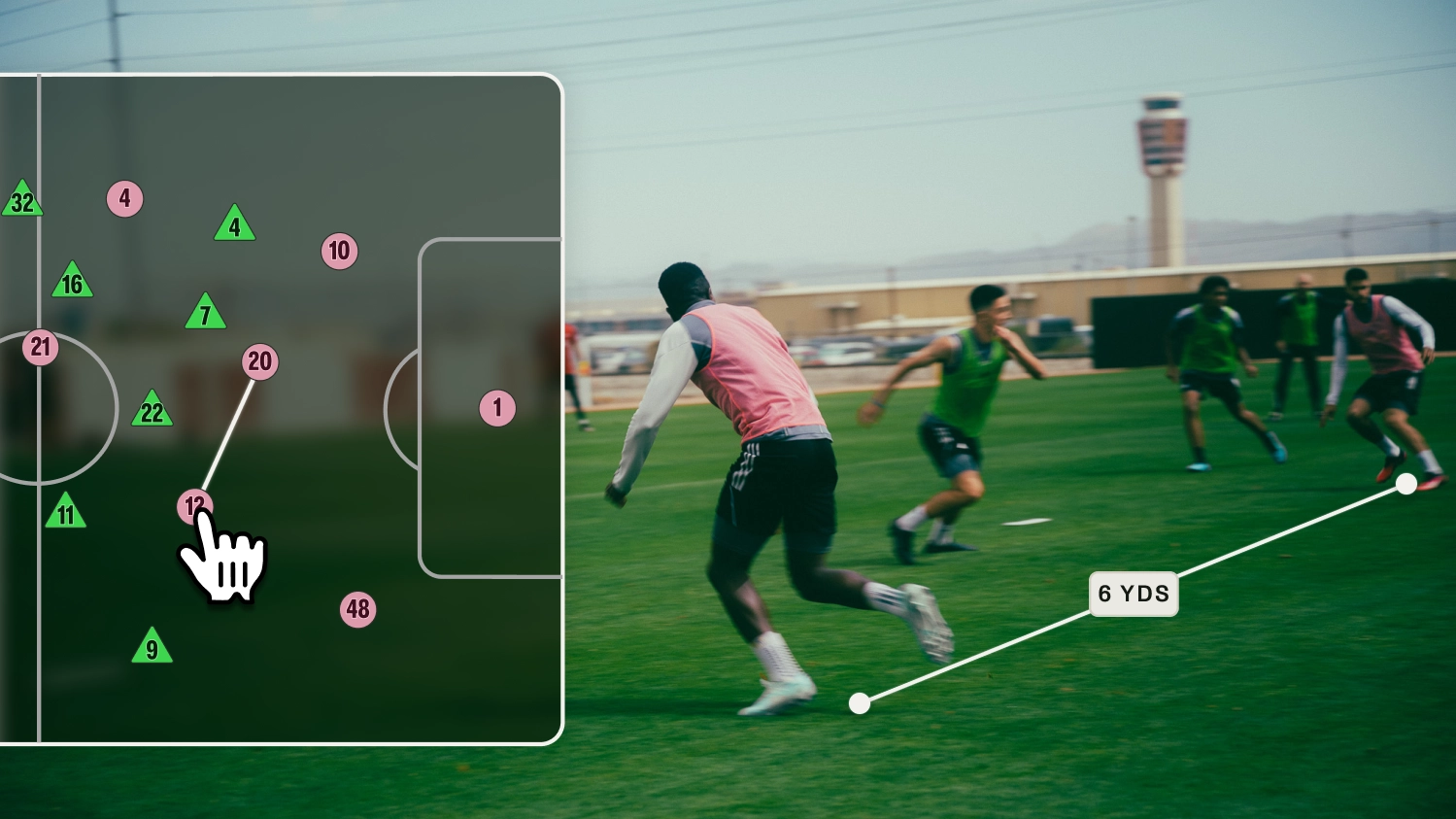
Learn how Veo's enhanced Connect Players feature brings connection lines and distance measurements directly into match footage. Discover the technology behind it and how coaches use it for tactical analysis.
We've enhanced the 'Connect Players' feature in the 2D Radar by bringing connection lines directly into match footage. Now, when coaches connect players in the radar view, those lines appear on the video itself, complete with distance measurements in yards that update as players move.
The technology builds on Veo's player tracking system, converting pitch positions into precise video coordinates for each frame. This allows coaches to visualize spatial relationships and defensive shapes directly on match footage, making tactical concepts immediately clear during video sessions.
Connect Players is available now in Veo Analytics for all users. To learn more about this enhancement, we sat down with Linda Skovmand, Software Engineer at Veo, and asked about the development process.
What inspired the decision to extend the 'Connect Players' feature from the 2D radar into actual video footage, and what specific coaching challenges were you aiming to solve?
It came together quite organically. In spring 2025, we finally solved the technical challenge of converting a player's position on the pitch to a precise coordinate on the video screen. This was a really exciting breakthrough because it opened up so many possibilities.

When we introduced the standard 2D player connections in the radar view later that year, it immediately felt like the natural next step to bring those connection lines into the video itself.
We know the 2D radar is great for tactical overviews, but there's something powerful about seeing these spatial relationships directly overlaid on actual match footage. It makes concepts more intuitive and easier to communicate during video sessions. You can show players exactly what "too wide" or "too compact" looks like in real game situations.
How does the technology maintain accurate distance measurements and line positioning as players move throughout the match?
It's all about combining several data streams in real-time. We take the player tracking data from our radar view, which gives us precise positions on the pitch, and combine it with the camera calibration information for that specific recording.
For each frame of the video, we know exactly where the virtual follow camera is pointing and how it's positioned relative to the pitch. We use this to project each player's pitch position onto the video frame, converting from 3D field coordinates to 2D screen coordinates. Once we have these positions, similar to what we do for Circle the Player, we draw the lines between them. The distance measurements are calculated based on actual positions on the pitch, so they remain accurate regardless of camera angle or zoom.
How do you envision coaches using the visual lines and distance measurements in practice?
The most immediate value is in team video sessions. Instead of switching back and forth between the radar view and video, or trying to describe distances verbally, coaches can now point directly at the footage and say "Look, you were 18 meters apart here, that's too much space for our pressing system."
It's brilliant for demonstrating tactical concepts like defensive lines, pressing triggers, or passing lanes. You can pause the video at a key moment, connect the defensive line, and immediately see if there are gaps opponents could exploit. Or connect an attacker to their nearest defender to show when pressing opportunities exist.
For individual player development, it's really useful too. You can show a midfielder exactly how far they were from their supporting players during a particular phase of play, which helps them understand their positioning decisions better.
I also think it'll be valuable in training preparation. If coaches notice their midfield consistently getting stretched to a specific distance before conceding chances, they can design training drills constrained to that exact distance. It allows them to take a data point from a match and turn it into a physical constraint on the training ground.
How do you envision this enhancement contributing to the overall coaching workflow in Veo Analytics?
What's exciting is how this fits into the bigger picture of what we're building. We already have Circle the Player for tracking individual movements, and now Connect Players for understanding spatial relationships. These features work together to give coaches a comprehensive toolkit for tactical analysis.
I see it becoming a standard part of the post-match review process. Coaches can quickly jump to key moments, connect relevant players, and have objective measurements right there in the video. No more estimating or debating distances, it's all based on actual tracking data.
Fundamentally, it's about making tactical insights more accessible and visual. Not every coach has time to dive deep into data tables and heat maps. With features like this, the insights come to them right where they're already working – in the video footage.